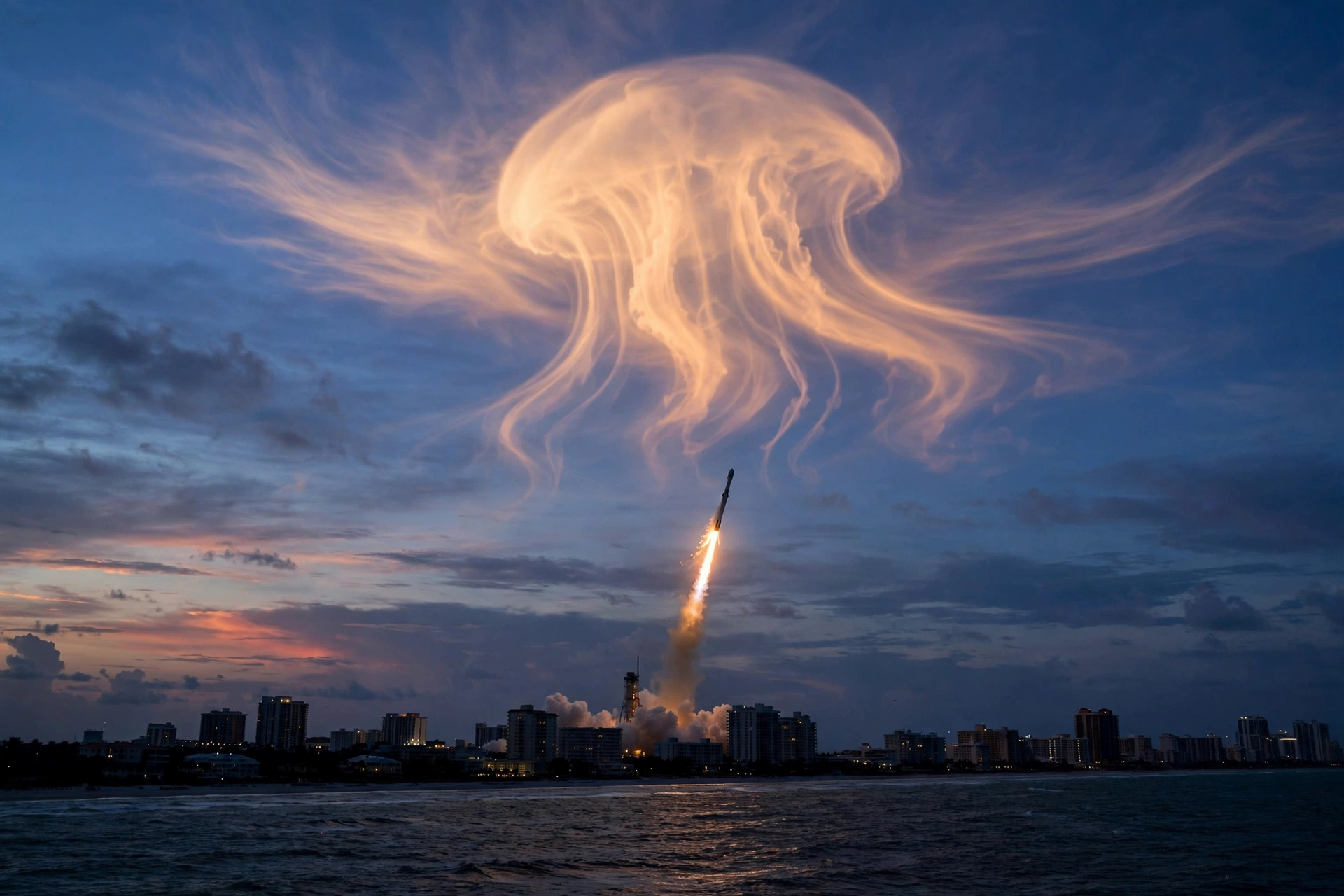

Residents along the US East Coast were treated to an unusual sight in the sky this week, when a SpaceX rocket launch produced a glowing, tentacled formation that witnesses quickly dubbed a ‘jellyfish cloud’. Photos shared from beaches, suburbs and city rooftops showed a bright core with long, translucent trails spreading beneath it, hanging in the twilight long after the rocket itself had disappeared from view. According to reporting by The Guardian, the display was visible across a wide stretch of the coast, prompting a wave of calls, posts and questions from people who had never seen anything like it.
What Exactly Is a Jellyfish Cloud?
The so-called space jellyfish is not a cloud in the ordinary weather sense at all. It is the exhaust plume of a rocket, expanding in the thin upper atmosphere. Near the ground, a rocket’s exhaust is held in a tight, bright column by the pressure of the surrounding air. As the vehicle climbs tens of kilometres above the surface, that pressure falls away, and the plume blooms outward into a wide, rounded shape. Long trails of vapour and unburned particles stream behind it, which is why the formation so often resembles a jellyfish drifting across the sky, complete with a glowing bell and trailing tentacles.
What makes the sight so striking is the timing. These displays almost always appear at dawn or dusk, when the ground below is already in shadow but the upper atmosphere is still lit by the sun. The plume catches that high-altitude sunlight and shines brilliantly against a darkening sky, while observers below stand in near darkness. It is the same geometry that makes some satellites and the International Space Station appear so bright when they pass overhead shortly after sunset.
Why the East Coast Sees Them So Often
Florida’s Space Coast has become one of the busiest launch sites on Earth, and the cadence of missions has risen sharply in recent years. Commercial satellite deployments, including large batches of communications satellites, now lift off on an almost weekly rhythm. Each early-morning or early-evening departure that climbs on a north-easterly trajectory can be visible from hundreds of kilometres away, which is why reports of glowing plumes now regularly arrive from the Carolinas, the mid-Atlantic and occasionally even further north.
Enthusiasts say the best seats are often far from the launch pad itself. Distance softens the roar and the glare, but it gives the plume time and altitude to expand into its full jellyfish shape. If you enjoy skywatching spectacles of a more natural kind, our coverage of the Blaze Star, which astronomers expect to erupt after an 80-year wait, is well worth a read.
The Science Inside the Glow
Researchers value these events for more than their beauty. A spreading plume is a visible record of conditions in the upper atmosphere: how it expands, bends and fades tells scientists something about winds, density and temperature at altitudes that are difficult to measure directly. Twilight launches have historically been used to study this region, because sunlit vapour trails stand out so clearly against the dark sky.
The colours in the display carry information too. The bright white core is largely sunlight scattering off water vapour and ice crystals in the exhaust, while fainter blue, green or reddish fringes can appear as different gases expand and interact with sunlight at extreme altitude. Photographers who captured this week’s event recorded exactly that range of colour, with the plume shifting in tone as it spread and thinned over several minutes.
Not a UFO, and Not a Weather Event
Every prominent jellyfish sighting follows the same social pattern: a brief burst of alarm and speculation, followed by a flood of spectacular photographs once the launch is identified. Officials and astronomers are quick to point out that the phenomenon is well understood, entirely man-made and harmless to people on the ground. The exhaust disperses at very high altitude and thins to nothing within minutes.
For readers interested in how patterns in nature connect to the wider universe, our explainer on natural occurrences that follow the Fibonacci sequence offers a different, earthbound kind of wonder.
How to Catch the Next One
The good news for skywatchers is that opportunities are frequent. Choose a launch scheduled shortly before sunrise or shortly after sunset, find a spot with a clear view towards the launch site and a dark sky overhead, and look up in the first few minutes after lift-off. The plume typically appears two to five minutes into flight, brightens as the rocket gains altitude, and can remain visible for up to ten minutes as it expands and fades.
Binoculars are unnecessary, though a phone camera on a steady surface can capture the colours surprisingly well. Above all, it is worth simply watching with the naked eye. As launch schedules continue to fill, the jellyfish cloud is becoming a regular feature of the East Coast sky — a brief, luminous reminder of how busy the space above our heads has become.