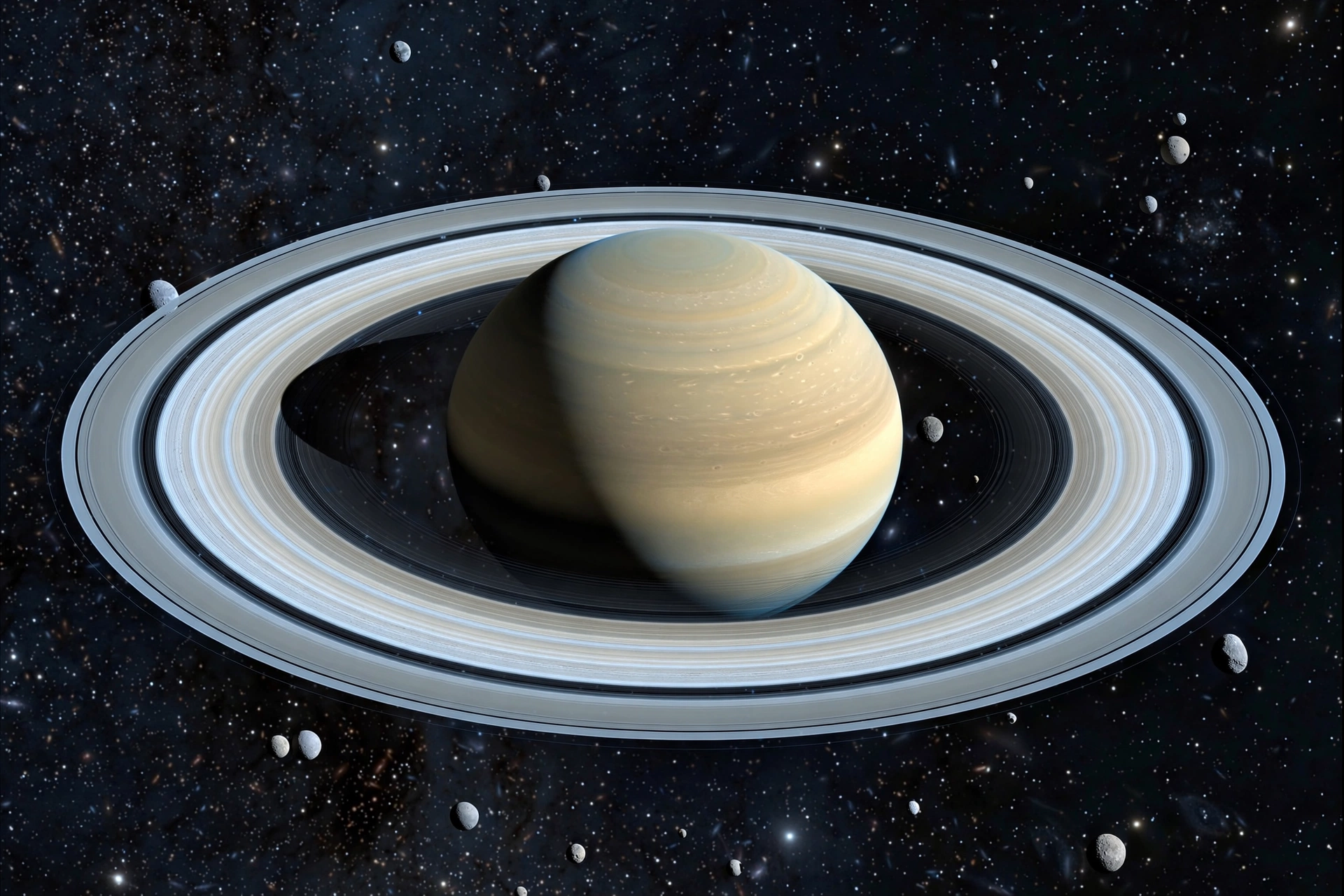

Saturn has pulled decisively ahead in one of astronomy’s friendliest rivalries. Researchers have confirmed 128 previously unrecognised moons orbiting the ringed planet, lifting its official total to 274 and giving it, by a wide margin, the largest family of moons anywhere in the solar system. The announcement settles, at least for now, a contest that has swung back and forth between Saturn and Jupiter for more than a decade as telescopes have grown sharper and surveys more patient.
The new moons are not grand worlds like Titan or Enceladus. Most are tiny, irregular fragments only a few kilometres across, travelling on wide, tilted and often backwards orbits far from the planet. Astronomers believe many are the shattered remains of larger moons that collided long ago, their debris slowly spreading into loose families that share similar paths around Saturn.
How the moons were found
The discoveries come from years of observations with the Canada-France-Hawaii Telescope on Mauna Kea, where a team led by researchers at the University of British Columbia used a technique known as shifting and stacking. By aligning dozens of long-exposure images on the predicted motion of faint objects, the astronomers could coax specks of light far too dim for any single photograph to reveal into clear view.
Each candidate then had to be tracked across multiple observing seasons to confirm that it truly orbits Saturn and is not a passing asteroid. Only after those orbits were pinned down did the International Astronomical Union, the body responsible for naming and cataloguing celestial objects, formally recognise the new moons. Background on the team’s wider work can be found via the University of British Columbia, whose astronomers have now helped catalogue a remarkable share of the outer solar system’s small moons.
It is painstaking work. A moon three kilometres wide, billions of kilometres away, reflects so little sunlight that it can hide in the glare of its own planet. The survey images had to be taken when Saturn was positioned against relatively empty patches of sky, and computers sifted through the results before human eyes checked the most promising trails.
Why 274 moons matter
A headline number is fun, but the scientific value lies in what these fragments record. Because the small moons preserve the scars of ancient collisions, their groupings let researchers reconstruct a rough history of impacts around Saturn. Some clusters appear to be only a few hundred million years old, young by solar system standards, suggesting the planet’s neighbourhood remains a busier and more violent place than once assumed.
The count also sharpens an old definitional question: how small can an object be and still count as a moon? For now, anything in a confirmed orbit qualifies, however tiny. If future surveys keep pushing the detection limit downwards, Saturn’s total could climb into the thousands, and astronomers may eventually need a size threshold simply to keep the catalogue meaningful.
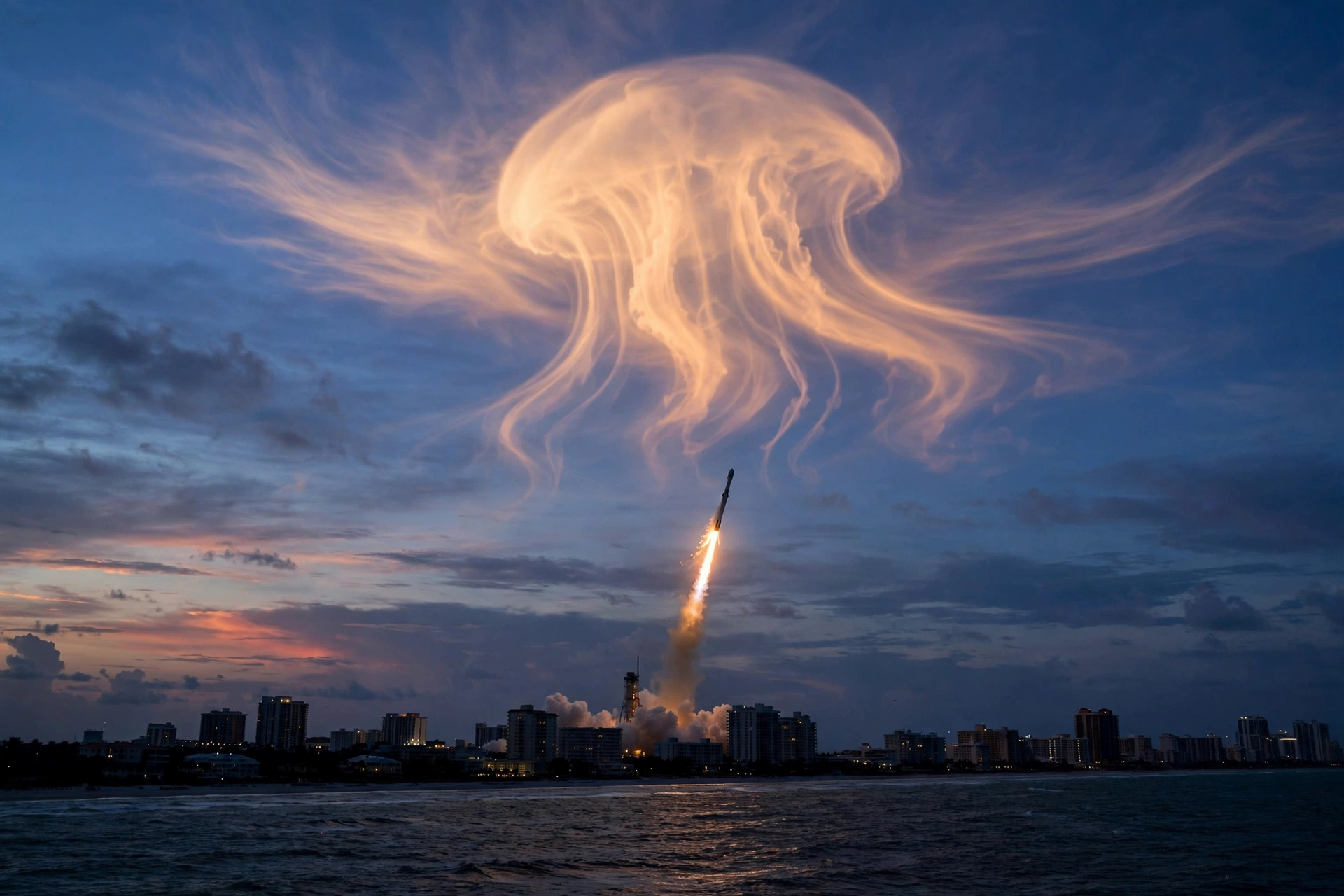
Readers who followed yesterday’s coverage of the rocket launch that painted a jellyfish cloud over the US East Coast will recognise the pattern: patient observation keeps rewriting what we thought we knew about the sky above us.
What happens next
Jupiter, with 95 recognised moons, is unlikely to reclaim the lead soon, although its own deep surveys continue. The Saturn team expects still fainter moons to emerge as image-processing improves and as the next generation of telescopes comes online. Each addition refines models of how giant planets gathered their retinues during the solar system’s formation, when gas, dust and colliding rock were gradually sorted into the orderly worlds we see today.
There is a pleasing symmetry in where the moons were found. Saturn itself was the first planet whose strangeness, its rings, forced astronomers to rethink what a planet could be. Four centuries later it is still doing that job, this time by sheer weight of numbers, and by reminding us that a catalogue is only ever a snapshot of what our instruments can currently reach. When the next generation of surveys begins, few astronomers would bet against the total rising again, perhaps substantially.
For now, the ringed planet stands alone. Two hundred and seventy-four moons is more than the totals of every other planet combined, a reminder that even in our own well-studied solar system, there is a great deal still waiting, quietly and dimly, to be noticed.