The global educational landscape has undergone a seismic shift. What began as an emergency response to a pandemic has evolved into a permanent fixture of modern pedagogy: Hybrid Learning. By blending traditional face-to-case classroom instruction with asynchronous online components, institutions have unlocked unprecedented flexibility.
However, this “best of both worlds” approach has introduced a unique set of academic pressures. As the boundaries between home and school blur, students are finding themselves navigating a more complex, self-directed environment. This shift is the primary driver behind the skyrocketing demand for external academic support services. In this article, we explore the data-driven reasons why the hybrid model necessitates a stronger support system for the modern learner.
The Cognitive Load of the “Dual-Mode” Learner
Hybrid learning isn’t just about attending a Zoom lecture on Tuesday and a physical seminar on Thursday. It requires a high level of executive function. Students must manage multiple platforms (LMS), keep track of varying deadlines, and transition between different modes of communication.
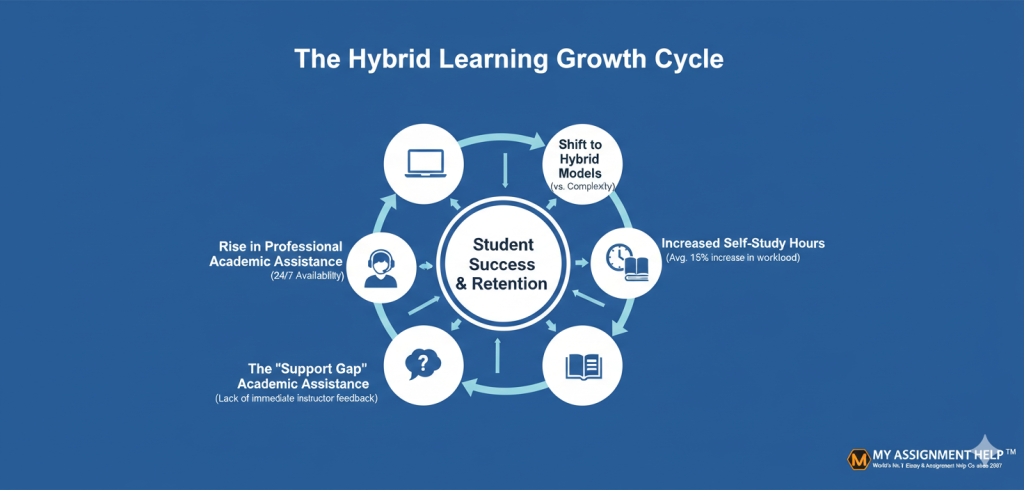
Research suggests that the “transactional distance”—the psychological and communication gap in a digital environment—can lead to feelings of isolation and confusion. When a student is sitting at home trying to decipher a complex calculus problem without the immediate ability to raise their hand, the frustration builds quickly. Consequently, more students are realizing they need assignment help to bridge the gap between digital delivery and conceptual mastery. This surge isn’t about a lack of effort; it’s about the need for personalized clarification that a 100-person hybrid lecture simply cannot provide.
Why Hybridity Increases Academic Pressure
The demand for support services like “MyAssignmentHelp” is rooted in three core challenges inherent to the hybrid model:
1. The Erosion of Peer Support Networks
In a traditional campus setting, “hallway learning” is a vital part of the academic ecosystem. Students often clarify doubts by talking to peers immediately after a lecture. In a hybrid setting, these organic interactions are minimized. When students find themselves stuck on a midnight deadline with no peer to consult, they naturally turn to professional services. Whether a student thinks, “I need someone to do my homework” or simply seeks a guided walkthrough of a problem, the lack of immediate peer access makes academic support a necessity rather than an elective.
2. The Shift Toward Asynchronous Responsibility
Hybrid models rely heavily on asynchronous work—reading, recorded lectures, and independent research. According to a study by EducationData.org, students in online or hybrid environments often spend 15-20% more time on self-directed study than those in traditional settings. This increased workload, coupled with the “always-on” nature of digital platforms, leads to burnout. Academic support services provide the scaffolding needed to manage this volume of work without compromising mental health.
3. Disparity in Digital Literacy and Resources
Not every student has a distraction-free home environment or a high-speed connection. The hybrid model assumes a level of technological parity that doesn’t always exist. Professional academic support levels the playing field, offering curated resources and one-on-one tutoring that helps students overcome technical or environmental hurdles.
Data Insights: The Support Surge
Recent industry reports indicate a significant uptick in the utilization of online tutoring and assignment assistance.
- Market Growth: The Global Private Tutoring market is projected to grow by over $8 billion by 2026, with a significant portion attributed to the rise of blended learning (Source: Technavio).
- Student Sentiment: A survey by Inside Higher Ed revealed that 43% of students in hybrid courses felt they needed more academic support than they did in fully in-person formats.
Key Takeaways
- Independence Requires Guidance: Hybrid learning demands high self-regulation; academic support provides the necessary framework for this independence.
- Accessibility Matters: Online support services offer 24/7 help, matching the 24/7 nature of hybrid digital platforms.
- Quality over Quantity: As students face more assignments, they prioritize expert guidance to ensure their grades remain competitive.
Conclusion
The hybrid learning revolution is here to stay, offering a future of education that is flexible and inclusive. However, we must acknowledge that this model places a heavier burden of responsibility on the student. The increased demand for academic support is a natural response to this evolution—a way for students to ensure that “flexibility” doesn’t come at the cost of “excellence.”
FAQ Section
Q: Is seeking academic support considered cheating?
A: Not at all. Academic support is a supplemental learning tool, much like a library or a private tutor. It is designed to provide clarity, improve writing skills, and help students understand complex concepts.
Q: How does hybrid learning differ from traditional learning?
A: Traditional learning is 100% in-person. Hybrid learning combines in-person instruction with online elements, allowing for more flexibility but requiring more self-discipline.
Q: Why do students prefer professional services over university-provided help?
A: While universities offer writing centers, they often have limited hours and long wait times. Professional services like MyAssignmentHelp offer immediate, 24/7 assistance tailored to tight deadlines.
About the Author: Dr. Sarah Jenkins
Senior Academic Consultant at MyAssignmentHelp Dr. Sarah Jenkins holds a Ph.D. in Educational Psychology and has over 12 years of experience in curriculum design and student advocacy. Currently serving as a Senior Content Strategist at MyAssignmentHelp, Sarah focuses on bridging the gap between digital educational tools and student performance. Her research focuses on the impact of blended learning on student retention and the importance of accessible academic scaffolding.
References:
- National Center for Education Statistics (NCES). “Impact of Distance Education on Postsecondary Students.”
- Technavio Research. “Global Private Tutoring Market Analysis 2022-2026.”
- Inside Higher Ed. “The 2023 Survey of Student Engagement in Digital Learning.”
- EducationData.org. “Online Education Statistics and Workload Metrics.”