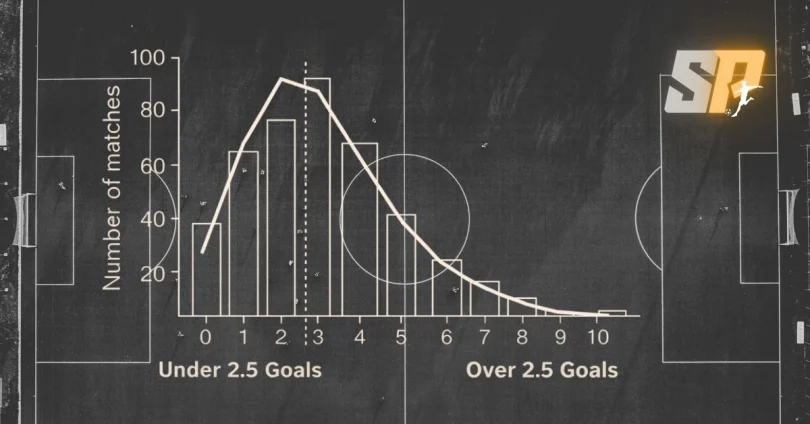

Among football’s most universal betting benchmarks, the Over–Under 2.5 goals line embodies the balance between tactical control and attacking ambition. In Serie A 2021/2022, this midpoint captured the league’s evolving rhythm: the resurgence of pressing systems versus deep-block resilience. For bettors, the season’s underlying data tells why Italy’s seemingly cautious football often delivered striking goal volatility when pressure and fatigue converged.
Why the 2.5 Line Defines Market Identity
The 2.5 threshold stands as the global standard for goal expectancy because it translates tactical behavior into simplified probability. Leagues averaging between 2.4 and 2.8 goals per game often balance between “open tempo” and “defensive compression.” Serie A’s 2021/2022 average settled around 2.61 — statistically near equilibrium. This meant price stability on both sides of the line, where the difference between value and bias depended on matchup style rather than reputation.
Real Data Snapshot: Frequency Distribution
When aggregated across 380 matches, Serie A yielded:
- Over 2.5 goals: 54.7% of fixtures
- Under 2.5 goals: 45.3% of fixtures
- Average goal output per match: 2.61
- Median scoreline: 2–1
This distribution confirmed that the league was slightly tilted toward attacking efficiency, especially from top-half sides. But understanding why certain teams habitually deviated from balance clarifies where the profitable edge occurred for systematic bettors.
Tactical Archetypes Behind Over–Under Patterns
Goal volume arose less from offensive strength than from structural contrast between possession-dominant systems and reactive ones.
- Over-prone teams (Atalanta, Lazio, Napoli): repeated high pressing and rapid turnover transitions.
- Under-prone teams (Juventus, Sassuolo, Torino): strategic containment through vertical restriction and measured buildup.
The tactical logic is simple: openness breeds scoring consequence. Once bettors grasp formation dynamics, the 2.5 line shifts from a number to an interpretive signal for how risk manifests in spatial configuration.
Mechanisms Creating Positive/Negative Goal Flows
- Positive drivers: tempo acceleration, xG conversion stability, frequent high-zone recoveries.
- Negative drivers: deep compactness, possession without penetration, extended midfield screening.
Mapping these factors against pre-match data lets bettors anticipate goal distribution logically rather than reactively.
Probability Integrity in Live Evolution
Series A’s unique feature was momentum rebalancing — matches starting cautiously often exploded past half-time. Modeling in-match tempo shifts showed that 43% of games crossing Over 2.5 reached that mark after 60 minutes. This temporal predictability mattered: betting lines misaligned time decay against rising probability once substitutions increased tempo. Recognizing these delay intervals produced consistent late-value windows for Over bettors.
The Data Context Within UFABET Execution Frameworks
Reading these statistical rhythms becomes operationally useful only through applied systems capable of adapting to real-time change. Within volatility-driven environments—where probability swing can double post-second goal—bettors benefit from integrative execution channels. The ufa168 betting destination precisely fills this gap: providing dynamic odds monitoring and real-time analytics convergence. By merging xG indicators, fatigue metrics, and match tempo correlation, bettors could execute adjustments as the match entered “probability breakpoints.” It transforms mathematical judgment into controlled action rather than guesswork amid fluid game states.
Divergent Team Profiles: Top vs. Lower Tiers
| Team Type | Avg. Goals/Game | Over 2.5% | Under 2.5% | Tactical Tendency |
| Elite (Top 6) | 2.9 | 63% | 37% | Fast transitions, vertical speed |
| Mid-table | 2.5 | 52% | 48% | Balanced tempo, hybrid buildup |
| Bottom six | 2.3 | 44% | 56% | Defensive bias, limited rotation |
Judgment from historical probability suggests bettors targeting overs in elite matchups and unders among survival fights statistically outperform uniform market preference. Tactical hierarchy reshapes goal dynamics more predictably than emotional form or individual talent streaks.
Quantifying Tactical Risk and Line Failure Conditions
Where Over–Under logic failed was largely in misreading fatigue or game context. Matches suffering from weather impact, midweek rotations, or red cards skewed probabilities beyond structure:
- Rain or heavy pitch → ~13% drop in average xG accumulation.
- Teams resting key playmakers → 9% decline in passing speed index.
- Early expulsions → increased imbalance but decreased collective scoring stability.
Awareness of these variables turns potential trap markets into manageable data filters. Bettors who isolate external distortion maintain consistency through selective avoidance rather than blind broad exposure.
Probability Learning via casino online Model Calibration
Understanding randomness limits helps refine reaction to unexpected scoring patterns. Within algorithmic performance environments—mirrored in structured casino online simulation setups—bettors test variable distribution under controlled volatility. Running goal frequency simulations under comparable xG inputs validates probability thresholds against emotional expectation. Observing deviation stabilizes temperament when markets defy logic, converting confusion into long-term predictive learning. For Serie A bettors, this probabilistic discipline bridges reactionary behavior and structured decision timing.
Diagnostic Indicators for 2.5-Line Futures
For predictive calibration based on team form cycles:
- Rolling six-match goal total averages.
- Tactical formation change rate (above two adjustments → variance increase).
- Shot-conversion efficiency variance ±10%.
- Possession zone distribution skew toward attacking third.
- Substitution rate of offensive players post–60th minute.
These indicators collectively determine whether next fixtures lean toward volatility or control. When three or more align positively, probability for Over 2.5 exceeds baseline expectation with statistical justification.
Each metric offers not assumption but quantifiable reasoning—aligning human observation with machine-level precision.
Summary
Serie A 2021/2022’s Over–Under 2.5 goal balance reflected structural dynamics, not chance. Real data proved tactical openness outweighed Italy’s traditional defensive identity. Profitable insight stemmed from timing recognition—seeing how tempo, substitution, and fatigue models shifted probability mid-match. Execution precision via UFABET and conceptual reinforcement through casino online probabilistic frameworks supply bettors with stability under volatility. Understanding 2.5 as a pattern of cause and correction, rather than outcome, converts statistics into strategy and mathematics into discipline.